In this guide
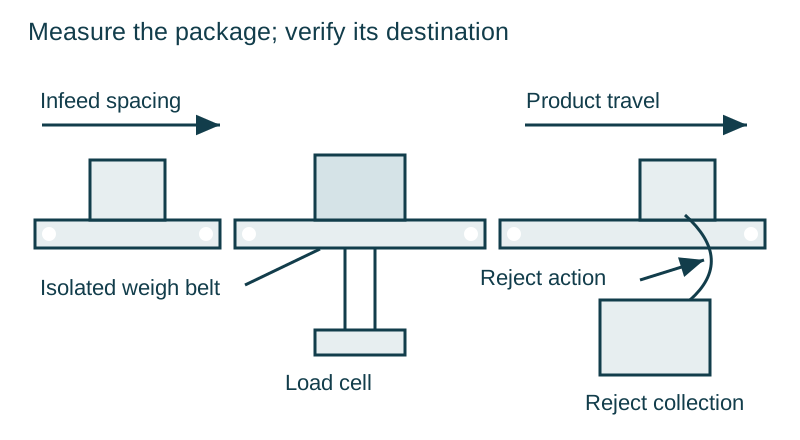
A checkweigher classifies individual packages while they move along a production line. Its useful output is a trustworthy decision attached to the correct package, followed by a controlled physical destination. Start a specification with the product and the verification procedure, then select the sensor, conveyor and communications around that job.
Define the package envelope
Record minimum and maximum gross mass, package dimensions in the travel direction, base stability, centre of gravity, orientation and the expected production rate. Include flexible bags, partly filled containers and products whose contents continue moving after transfer. A package that rocks or touches a guide can apply forces beyond its weight to the measuring belt.
State the washdown method, available space, vibration sources, air currents and utilities. Specify the real transfer heights and product spacing. Treat a quoted maximum speed as a capability for stated conditions; it is not a promise that every package will meet the same weighing tolerance at that speed.
Select the complete measurement
The sensing element may use strain gauges or electromagnetic force restoration. Either design still depends on controlled loading, a suitable measuring interval and appropriate signal processing. Sensor resolution, the displayed weight increment and the repeatability of a moving package are different properties. Specify which one a supplier must demonstrate.
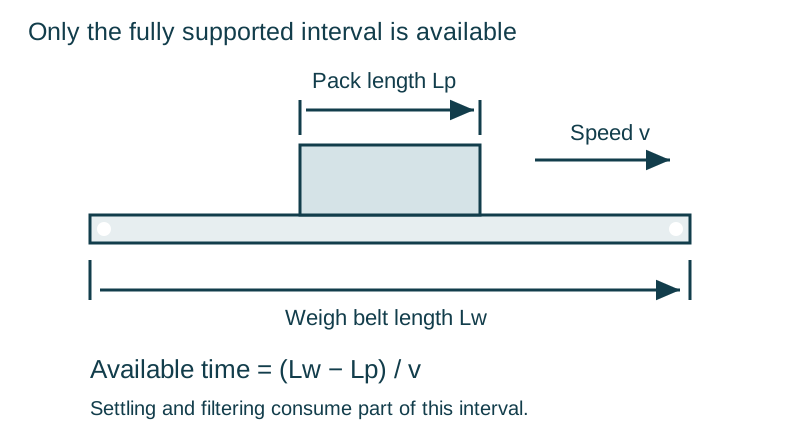
For a package fully supported by a weigh belt, the geometric opportunity for measurement is (weigh-belt length − package length) / belt speed, using consistent units. Transfer settling, signal filtering and the decision process must fit inside that opportunity. A package spanning two conveyors, or a second package entering the scale, changes the loading condition.
| Selection item | Evidence to request | Production condition to preserve |
|---|---|---|
| Weight classification | Repeated passes of traceably weighed representative packages | Speed, orientation and spacing |
| Mechanical transfer | Trial of the least stable package | Belt heights, gaps and guide clearance |
| Reject performance | Underweight and overweight challenges with confirmed collection | Air pressure or actuator readiness |
| Fault response | Challenge of installed fail-safe functions | Alarm routing and recovery procedure |
| Traceability | Export showing product, time, result and relevant events | Clock, recipe and batch identification |
Match the reject mechanism to the package
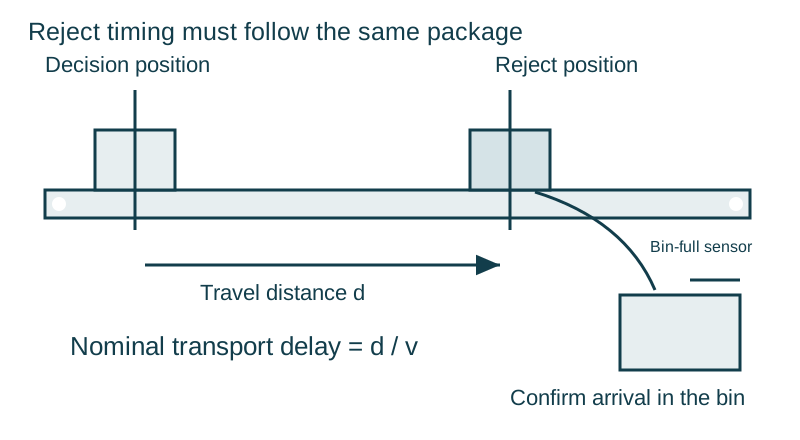
An air jet may suit a light, stable pack; a pusher, diverter or drop-through arrangement can be more appropriate for other package masses and geometries. Compare the required movement, available time, damage risk and the recovery of adjacent acceptable packages. Select the mechanism through trials rather than package mass alone.
A reject command proves that the controller asked for an action. Reject confirmation proves a later event, such as the package reaching the collection area. Bin-full, door-open and low-air functions add distinct checks where fitted. Include a controlled response when the reject system cannot guarantee segregation.
Make records useful to the next investigation
Wintech’s WT-600 documentation describes dated event and result records, recipe memory and communications options. Those features belong to that product configuration; confirm the exact protocol, licensed software, message content and export method in the quotation. A port name by itself does not establish what a supervisory system can read.
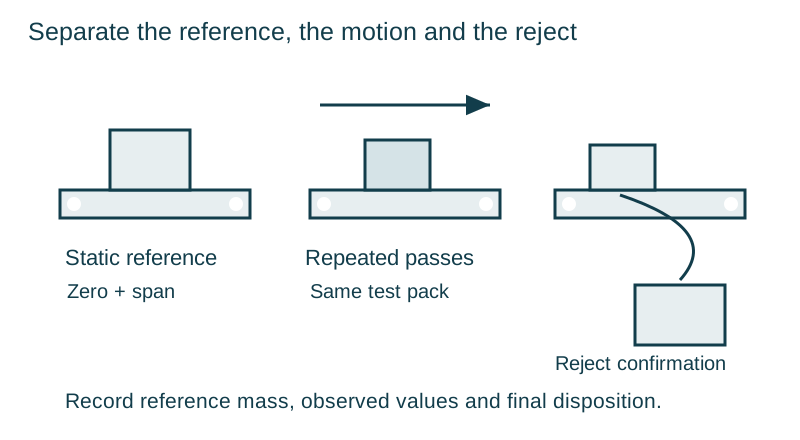
For each trial, link the package identifier, reference mass, indicated result, classification and final destination. Preserve recipe and line settings alongside the results. This separates a drifting reading from a correct reading followed by an incorrectly timed reject.
Read: METTLER TOLEDO — Testing Solutions Catalogue.
Read: OIML R 51-1 — Automatic catchweighing instruments.
Agree acceptance before the trial
The METTLER TOLEDO Testing Solutions Catalogue, in its dynamic checkweighing section, calls for verification of weighing accuracy, reliable rejection, warning functions and installed fail-safe systems. Use those as separate acceptance headings. Agree the applicable tolerances, sample plan and frequency with the responsible quality and metrology personnel.
OIML R 51 addresses automatic catchweighing instruments; the legal requirements for a particular package and market depend on the applicable regulatory regime and instrument approval. A checkweigher supports a net-content control programme, while tare control, sampling and disposition procedures complete the programme.
Continue with the checkweigher selection and verification guides.