
Choose the measurement boundary
A weighing system can measure material before it enters the pack, measure the receiving package, or monitor the loss of mass from a supply hopper. Start by drawing that boundary. It determines which forces and transfers affect the result.
| System | What it measures | Selection question |
|---|---|---|
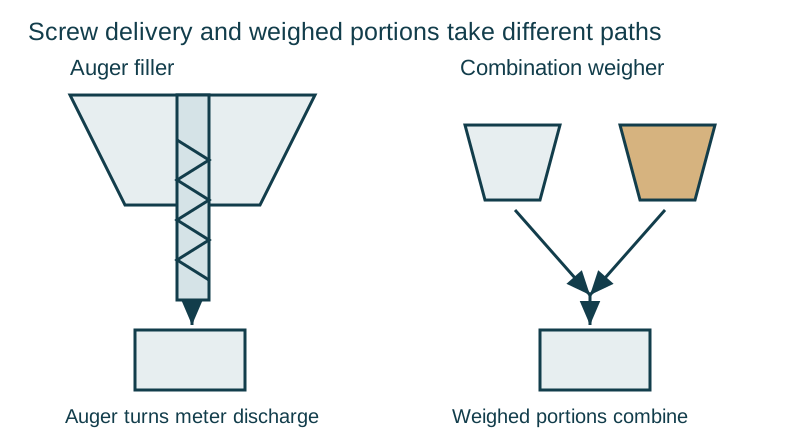
| Multihead combination weigher | Separate hopper portions | Can enough suitable portions be prepared and released in time? |
| Linear net-weight scale | A portion accumulating in a weigh hopper | Can coarse and fine feeding reach the target within the available cycle? |
| Net-weight auger filler | Delivered mass with screw feeding | How does the cutoff respond to density and product in flight? |
| Loss-in-weight feeder | Rate of mass decrease in the supply assembly | How are refill, venting and external connection forces handled? |
Match the mechanism to the material
Particle size, cohesion, aeration, moisture and fragility affect replenishment and discharge. Evaluate the product after its normal storage and handling, including the conditions that make it hardest to dose.
Connect accuracy with line timing
A precise portion must arrive inside the packaging machine's acceptance window. Include gate movement, product travel and sealing timing in the trial. For continuous feeders, compare steady flow and refill transitions.
Start with a practical question
Learn the multihead weighing sequence, compare multihead and auger filling, or identify the feedback boundary in volumetric and gravimetric control. For a continuous powder process, use the loss-in-weight feeder guide.