In this guide
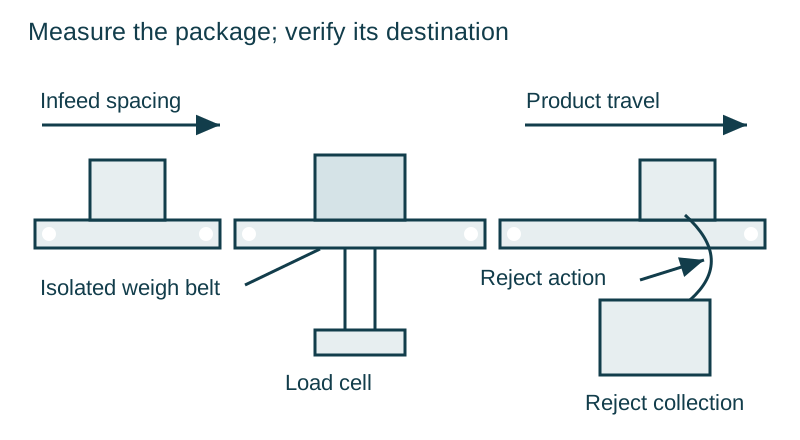
A dynamic checkweigher needs enough time to measure a stable package and enough control of the downstream path to remove the correct one. Specify belt geometry, product spacing, measurement processing and reject verification together. A calibrated static reading is the starting point for this moving application.
Calculate the fully supported interval
Let Lw be the effective weigh-belt length, Lp the package length in the direction of travel, and v the actual belt speed. When the package is fully supported on the isolated belt, the geometric interval is tavailable = (Lw − Lp) / v, provided Lw is greater than Lp. With lengths in metres and speed in metres per second, the result is in seconds.
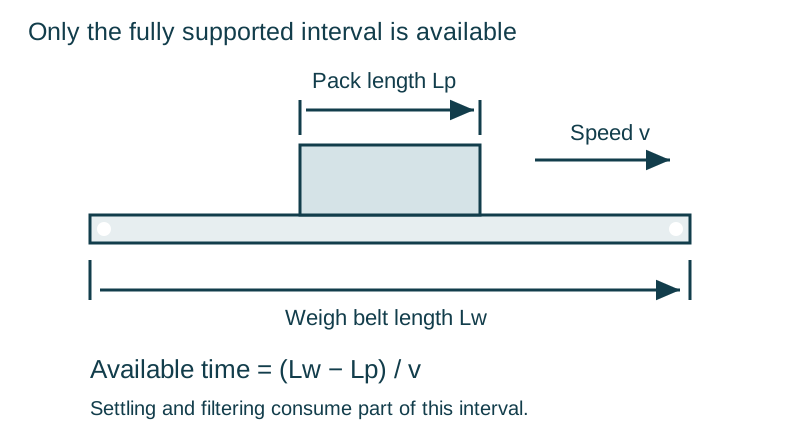
This interval begins after the trailing edge clears the upstream transfer and ends when the leading edge reaches the downstream transfer. Settling, filter response and the measurement decision must fit within it. Package rocking, sloshing or contact with guides can consume usable measurement time even when the geometric calculation appears adequate.
Check spacing and occupancy separately
For line rate r in packages per second, nominal pitch is p = v / r. For packages of travel length Lp, nominal gap is g = p − Lp. Use the longest package and the tightest real spacing, including variation introduced by upstream equipment.
A positive empty-belt interval between packages requires p > Lw + Lp in this simple geometry. Its duration is tempty = (p − Lw − Lp) / v. Equality leaves no finite empty interval, so allow the additional time required by the instrument for empty-belt detection and zero tracking. Other spacing strategies may be supported by a particular machine’s detection and weighing logic. Confirm the permitted occupancy pattern with the manufacturer and demonstrate it in the trial; pitch alone does not prove valid measurement windows.
| Input | Obtain from | Use in acceptance |
|---|---|---|
| Actual belt speed | Measured or verified conveyor setting | Dwell and transport calculations |
| Package travel length | Worst-case production format | Fully supported interval |
| Pitch distribution | Observed line spacing | Occupancy and detection reliability |
| Measurement processing | Authorized recipe and instrument settings | Settling and filtering budget |
| Reject travel distance | Decision reference to actuator location | Package tracking and delay |
Separate static calibration and dynamic compensation
Perform the manufacturer’s zero and reference-load procedure with suitable traceable weights. Preserve the as-found result before adjustment. Then run identified representative packages repeatedly at operating speed and compare their indications with suitable reference masses.
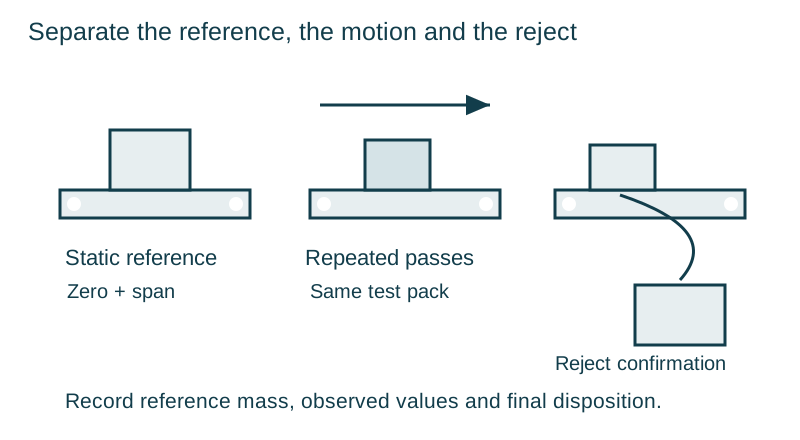
A systematic dynamic bias may be addressed through the authorized compensation procedure. First investigate excessive variation: compensation of an average cannot correct unpredictable rocking, contact or vibration. Retain individual pass results and distinguish mean error from repeatability.
The METTLER TOLEDO Testing Solutions Catalogue identifies weighing accuracy, reliable rejection, warning functions and installed fail-safe functions as separate verification objectives. Set acceptance limits and intervals through the applicable equipment and quality procedures.
Keep zero tracking tied to a valid empty state
An automatic zero function must operate only under the instrument’s permitted empty-belt conditions. Inspect product detection, residual product, belt contamination and external contact when zero changes unexpectedly. A package or material retained on the measuring assembly must not be treated as a normal empty baseline.
Verify recovery after a stop, a gap in production and a restart. Keep any zero-tracking or dynamic compensation changes in the recipe history, especially where metrological settings are protected or subject to official control.
Verify the complete reject chain
For fixed belt speed, nominal travel delay from a decision reference to a reject point is distance / speed. Actuator response and package geometry determine the actual command window. If speed changes, the tracking strategy must preserve the package’s position rather than relying on an obsolete fixed timer.
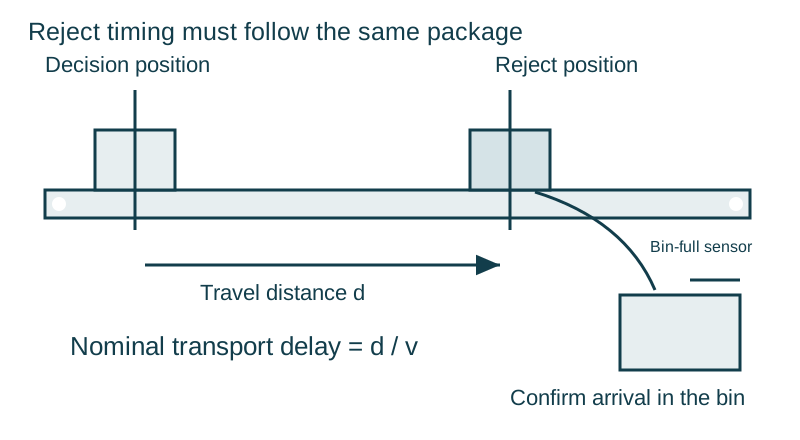
An air jet needs sufficient and monitored air supply for its validated package range. A pusher or diverter needs a suitable stroke, cycle time and return condition. Trial adjacent acceptable packages as well as isolated rejects to check that the mechanism neither misses the target nor removes its neighbour.
Challenge the installed reject-confirmation, bin-full and related fail-safe functions according to the safe test procedure. A full collection bin or failed actuator must trigger the defined response before segregation becomes unreliable. Confirm alarms reach the intended operator or supervisory system.
Release the application with a reproducible record
Keep package identifiers, reference masses, actual speed, geometry, spacing, recipe, individual results and final destinations together. Repeat the relevant checks after format changes, transfer work, belt replacement or changes to the reject mechanism. Apply local metrological and net-content requirements to the complete application rather than inferring compliance from one sensor specification.
Continue with the checkweigher selection and verification guides.