In this guide
Combination-weigher accuracy depends on the portions available for selection and on their complete transfer into the package. Head count changes the set of possible portions; feeder balance, measurement settling and synchronized discharge determine how much of that potential is usable on a VFFS line.
Read: Ishida — Multihead Weighers Range Brochure.
Compare head layouts through available combinations
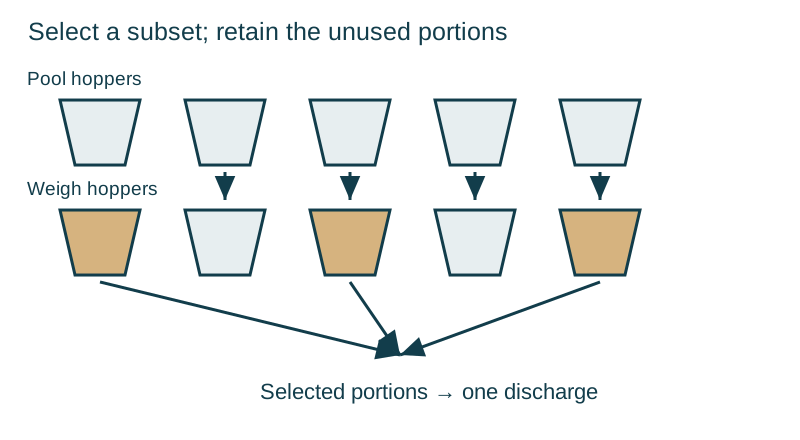
With n eligible heads and a selection of k heads, C(n,k) = n!/[k!(n−k)!] describes the number of possible fixed-size subsets. The controller evaluates hopper totals against its target and acceptance rules. It may exclude unstable, empty, inhibited or otherwise unavailable heads, and it may apply mixing or outlet constraints.
A 10-, 14- or 24-head label therefore needs a configuration drawing. A larger machine may divide its heads among several products or discharge outlets. Count the heads available to the actual portion rather than assuming that every physical hopper participates in every decision. Controller computation is only one part of the cycle; product feeding, settling and transit also consume time.
Ishida’s brochure provides concrete configuration examples. Its table compares 10- and 14-head arrangements; the multi-mix/multi-outlet section lists the CCW-RV-224B-**-15,20,30-SS,WP family for 24 heads. These are Ishida configurations, with the suffixes identifying options in that brochure. Confirm the complete ordered configuration before applying its dimensions, capacities or throughput to a project.
| Layout question | Why it changes the comparison |
|---|---|
| How many heads are eligible for one portion? | Mixing and outlet grouping can restrict combinations |
| Which hopper stages are installed? | Pool, weigh and booster stages change buffering |
| How quickly are emptied heads replenished? | Starvation reduces the useful choice set |
| How long does each reading need to settle? | An occupied hopper may still be unavailable |
| How is the portion collected and released? | Transit and gate sequencing set the bagger handoff |
Balance main and radial feeding
The main dispersion stage supplies the radial feeders, and those feeders prepare the individual hopper portions. If supply is uneven, the controller may repeatedly rely on a limited set of heads. Excessive portions also reduce useful choices when their masses are poorly matched to the target.
Observe hopper occupancy and portion distribution before changing vibration. Adjust only the parameters authorized for the actual machine and product. Record the product state and the original recipe, then evaluate one change at a time through head availability, final package variation and damage.
Handle fragile and sticky products differently
For fragile expanded foods, assess damage at the dispersion table, hopper gates, collection chute and forming tube. The impact history includes every drop. Gentler feeding and shorter or controlled falls can help, but changes must preserve consistent replenishment and complete release.
For frozen or sticky material, inspect adhesion, clumping, surface moisture and incomplete gate clearing. Embossed or otherwise specialized contact surfaces are application options; compare actual release and cleaning with the representative product. A textured surface is not automatically the correct solution for every sticky material.
Kenwei’s pickle-weigher guidance identifies residues, moisture and gate/mechanism condition as practical troubleshooting areas. Apply that evidence to the product and machine being evaluated, including food-contact and cleaning requirements.
Synchronize with the VFFS acceptance window
Trace the bagger request, selected hopper release, any collector-hopper action, the first and last product arrival, and jaw closure. The important endpoint is the last part of the portion clearing the sealing area. If the product tail is too long, a correctly weighed portion can be split or caught in the seal.
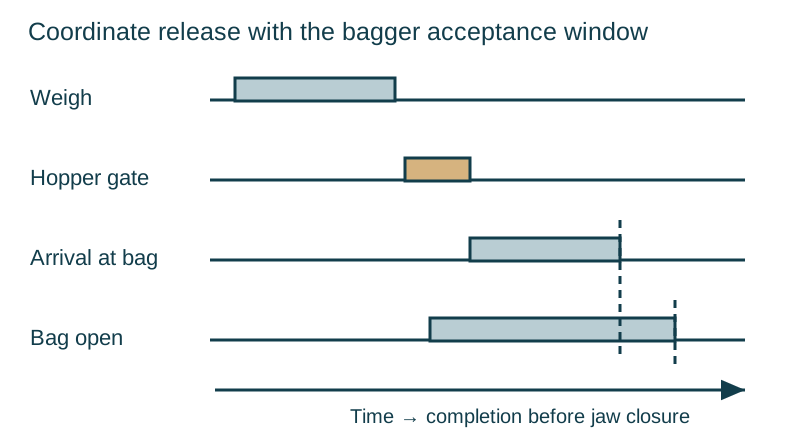
A collector hopper or sequenced discharge can change how the product slug forms. Set timing using the installed geometry and product observations. Maintain sufficient margin for normal variability and verify starts, stops and speed changes as well as steady operation.
Verify measurement readiness before chasing speed
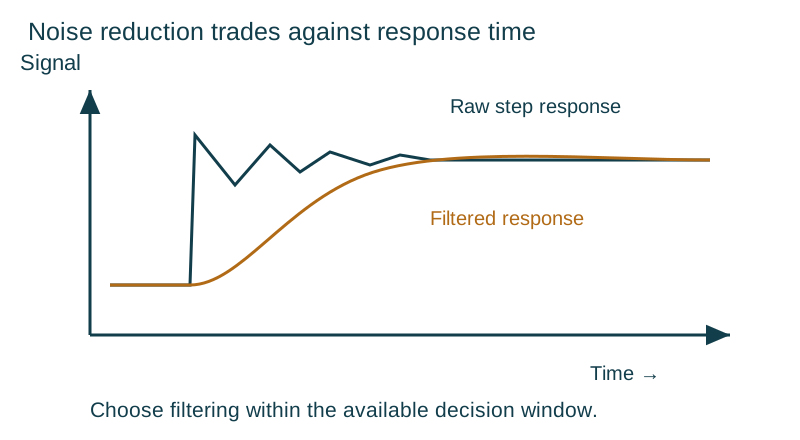
A filter can suppress vibration while delaying the reading used for selection. Check mechanical isolation and residual product before increasing filtering. Compare the combination total with reference measurements of finished packages to distinguish weighing variation from transfer loss.
Record the head configuration, target, material condition, recipe, line speed, available-head pattern and package results. Use those records to decide whether the next improvement belongs in feeding, measurement settling or the VFFS handoff. The troubleshooting sequence provides a structured way to isolate the cause.
Continue with the packaging weighing systems collection.