In this guide
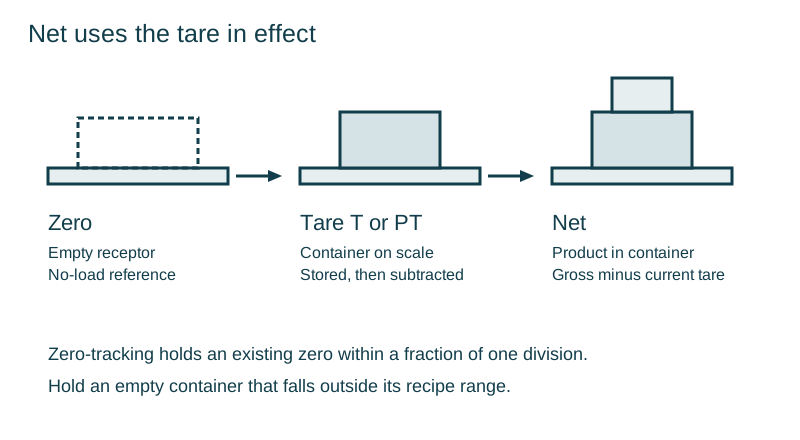
Net weight on a packaging scale is the gross weight minus the tare in effect for that package. Zero, measured tare, and preset tare update different stored values. A control that forces a zero reading while a container sits on the load receptor moves the container into the scale reference and drops it from the tare record.
Assign each update to one device
OIML R 76, for non-automatic weighing instruments, and OIML R 51, for automatic catchweighing instruments, use the same split. A zero-setting device sets the indication to zero when there is no load on the load receptor. A tare device sets the indication to zero when a load is on the receptor. Additive tare leaves the weighing range for net loads unchanged. Subtractive tare reduces that range. A preset tare device subtracts a value introduced into the instrument, and the weighing range for net loads is reduced accordingly.
| Device | Value it updates | Condition |
|---|---|---|
| Zero-setting | No-load reference | Receptor empty, indication stable |
| Tare-weighing | Stored tare, marked T | Empty container on the receptor, stable, inside the tare device’s maximum effect |
| Tare-balancing | Indication brought to zero | Container on the receptor, tare value hidden while the instrument is loaded |
| Preset tare | Predetermined value, marked PT | Entered, recalled, or identified with that container |
| Zero-tracking | Small correction of an existing zero | Indication already at zero, or at a negative net equal to gross zero, and stable |
OIML R 51 defines gross as the indication of the load with no tare or preset tare in operation. Net is the indication after a tare device operates. Calculated net is the difference between a gross or net value and a preset tare. With a tare in effect, net equals gross minus the current tare. That current tare is the stored T or the active PT. NIST Handbook 44 applies the tolerance, when tare is in use, from the tare zero reference (zero net indication) to the net indication, for any tare load, using certified test loads.
Handbook 44 requires the tare mechanism to operate only in the direction of underregistration relative to the zero-load balance. The tare division equals the scale division, except on a digital monorail scale and on multi-interval or multiple range scales when tare is determined in a lower weighing range. A device that clears tare automatically has to wait until the transaction is complete. The handbook’s note includes tare, net, and gross determination in that complete operation. The tare-division and automatic-clearing clauses are nonretroactive as of January 1, 1983.

Weigh the container, or apply a preset value that belongs to it
A tare-weighing device stores the tare and can display or print it whether or not the instrument is loaded. A tare-balancing device sets the indication to zero with the container on the receptor, and the tare value stays hidden while the instrument is loaded. Store T on a packaging scale so the empty weight can be compared with the range recorded for that format.
Preset tare is determined once and then used for other weighings. OIML R 51 describes it as a predetermined value, introduced by keying, by recall from storage, or through an interface. The NIST weighing FAQ gives the Handbook 44 counterpart: a stored tare or keyboard tare entered into the scale while it weighs the gross load. Gross, net, and tare indications from that operation are subject to the handbook’s stored-tare and keyboard-tare requirements. When a computer subtracts two gross weighments, each gross value is a scale indication and the difference is arithmetic outside the instrument. The FAQ states that rule for a truck scale. A packaging line needs the same distinction between two gross drafts and a tare value entered into the scale.

On a gain-in-weight filler, product arrives in the container just tared, so the empty container is weighed on that instrument. The volumetric and gravimetric filling comparison separates that receiving-vessel measurement from loss-in-weight feeding and from a later check of the closed pack. Preset tare fits when the container identity selects a value already established for that identity. R 51 allows a preset tare device to operate automatically only when the preset tare value is clearly identified with the load, for example by barcode identification on the container.
R 76 and R 51 both keep a preset tare from being modified or cancelled while any tare device operated after the preset tare is still in use. Print PT with a calculated net, and T with a weighed tare.
Displayed gross, net, and tare are rounded separately. In the R 76 worked example for a Class III instrument with Max = 15 kg and e = 5 g, an internal gross of 14.561 kg is displayed as 14.560 kg, an internal tare of 2.728 kg is displayed as 2.730 kg, and the displayed net is 11.835 kg. Adding the displayed net to the displayed tare does not recover the displayed gross. The NIST FAQ says the net should be determined from the measured gross and tare, with rounding of the net as the last step. Record the instrument’s net. A one-interval difference among the three displayed figures is a rounding result, and moving zero will not repair it.
Handbook 44, S.1.1.1, nonretroactive as of January 1, 2025, requires that after zero-setting (gross zero or net zero after a tare operation) the effect of zero deviation on the weighing result be not more than ± 0.25 e.
Keep zero-tracking inside its window
Zero-tracking maintains a zero that is already indicated. OIML R 76 allows it only when the indication is at zero, or at a negative net value equivalent to gross zero, equilibrium is stable, and corrections are not more than 0.5 d per second. After a tare operation, zero-tracking may operate within 4% of Max around the actual zero.
Handbook 44 limits the load that automatic zero-tracking can rezero when that load is placed on or removed from the platform all at once under normal operating conditions. For scales manufactured on or after January 1, 2007, the limit is 0.5 scale division, and 3.0 scale divisions for vehicle, axle-load, and railway track scales. For scales manufactured between January 1, 1981, and January 1, 2007, the limit is 0.6 scale division for bench, counter, and livestock scales, 3.0 scale divisions for vehicle, axle-load, and railway track scales, and 1.0 scale division for other scales.
The overall effect of zero-setting and zero-tracking devices is not more than 4% of maximum capacity in both R 76 and R 51. Initial zero-setting, which runs at switch-on before the instrument is ready for use, is not more than 20% of maximum capacity, unless tests show that the instrument still meets its error limits for any load that device compensates. Handbook 44 states that 20% ceiling for the initial zero-setting mechanism on Class I, II, and III scales whose weighing, load-receiving, and indicating elements share a housing or a Certificate of Conformance, with the same test exception. For an indicating element on a separate Certificate of Conformance, the initial zero-setting range shall not exceed 20% of the configured capacity. That separate-indicator limit is nonretroactive as of January 1, 2009.
An empty pouch, jar, or carton sits outside a half-division tracking step. Residue near one division can move zero. Container weight belongs in tare.
R 51 treats automatic zero-setting as its own device. It may operate at the start of automatic operation, as part of every automatic weighing cycle, or after a programmable time interval. It runs only when the stability criteria are fulfilled, and often enough that zero stays within 0.5 e. Where it operates on every cycle, it cannot be disabled or turned into a timed interval. Where it operates on a timer, the manufacturer specifies the maximum interval, and that interval has to keep the zero error within 0.5 e. R 51 notes that zero-tracking may run continuously and is therefore rate-limited, and that many catchweighers use automatic zero-setting rather than zero-tracking.
During automatic operation, R 51 requires that a non-automatic or semi-automatic zero-setting device shall not be operable, and that a non-automatic or semi-automatic tare device shall not be operable. The empty-belt reference belongs to the automatic zero-setting device. Container weight belongs to automatic tare, or to a preset tare identified with the load.

If the programmed zero-setting interval elapses, R 51 requires the instrument to set zero, to stop so a zero-setting operation can occur, or to signal that zero-setting is overdue. That stop protects the empty-scale reference.
Hold the container when its empty weight is outside the recipe range
Write the empty-package weight range and the scale division into the format recipe. R 76 and Handbook 44 do not publish a universal empty-pouch limit. The range comes from the containers used for that format. The division is the division of the instrument that weighs them.
Before product is delivered:
- Clear the previous tare so the empty container is read as a gross weight.
- Compare that reading with the recipe range, and confirm it is inside the tare device’s maximum indicated effect. R 76 and R 51 both prohibit use of the tare device at or below its zero effect or above its maximum indicated effect.
- When both checks pass, store the measured tare or accept the preset tare identified with this container. While tare operates, the net indication is marked NET, Net, or net. The preset tare value has to be available at least temporarily.
- When either check fails, stop product transfer into that container and hold the container. Resolve the empty weight, the recipe, or material left on the receptor before the next fill.
A semi-automatic zero-setting device functions only in stable equilibrium, and it cancels any previous tare operation. Zero-setting is defined for an empty receptor. Using it on an out-of-range container cancels the tare record and shifts the no-load reference while a load is present. The hold in step 4 is the action that belongs to that container.
Subtractive tare reduces the range left for product. When the residual weighing range is unknown, the instrument must prevent use above maximum capacity or indicate that capacity has been reached. An acceptable heavy container plus the target fill can reach that limit. Treat that event as a capacity hold, and keep the empty-weight comparison as its own check.
Handbook 44 allows a combined zero and tare (0/T) key on scales not intended for direct sales, provided the key’s function is clearly marked and the words “Not for Direct Sales” appear on or adjacent to the weight display. OIML allows one key to operate both semi-automatic zero-setting and semi-automatic tare-balancing. Where the instrument has a zero-setting device and a tare-weighing device, the zero-setting control shall be separate from the tare-weighing control. Separate controls, and a printed T or PT, show which value changed.
Calibration, adjustment, and routine verification of a checkweigher stay in the checkweigher calibration guide. Dynamic setting, the adjustment that removes the difference between a static load value and a dynamic load value, is a different operation from tare and from zero.
Leave a record the next shift can check
For each format, keep the empty-package weight range, the scale division, whether the tare was weighed (T) or preset (PT), the identification that selected a preset tare, and whether zero-tracking or automatic zero-setting is enabled. After a hold for an out-of-range empty weight, record the observed empty weight beside the recipe limits.
Send the empty-package weight range and the scale division of the instrument that tares the container. Those two figures are the recipe limits for the hold.
Continue with the packaging weighing systems collection.