In this guide
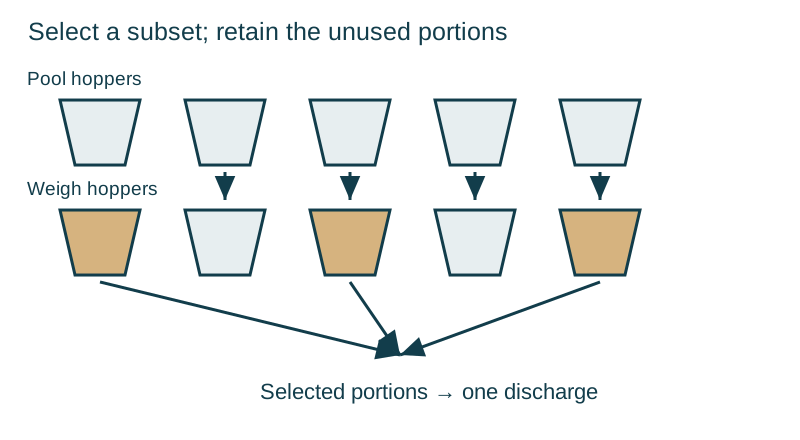
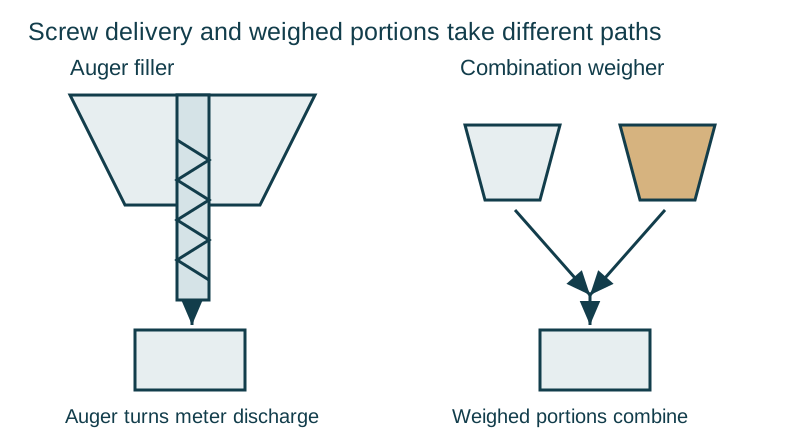
Choose a multihead weigher or auger filler by testing how the product flows and how the dose is measured. A multihead weigher combines separately weighed portions. An auger moves product through screw flighting and can operate with volumetric settings or with weight feedback. The screw mechanism alone does not tell you whether the filling control is gravimetric.
Start with the material, not the machine name
Record particle-size distribution, cohesion, bulk-density variation, aeration, surface moisture, temperature, dust generation and acceptable product damage. Include the worst expected condition after transport, storage or a process change. Free-flowing granules and cohesive powders create different feeding problems, but many products sit between those categories.
Ishida documents dispersion, radial feeding and hopper combinations for multihead machines. Spee-Dee describes auger applications for both free-flowing and non-free-flowing materials and offers a net-weight range. These are useful starting points for trials rather than absolute boundaries between equipment types.
Compare the mechanisms on the same basis
| Decision factor | Multihead combination weigher | Auger filler |
|---|---|---|
| Dose formation | Selects a subset of weighed hopper portions | Delivers material through a rotating screw |
| Feedback | Individual hopper weights inform the selection | Turns/time, or a scale in a net-weight configuration |
| Product behaviour | Consistent distribution and complete hopper release | Consistent screw filling and controlled discharge |
| Typical concern | Breakage, sticky retention, uneven feeding | Bridging, aeration, dribble and density variation |
| Interface | Portion release synchronized with package availability | Screw operation synchronized with container or bag |
| Cleaning review | Hoppers, feeders, gates and chutes | Hopper, agitator, screw and discharge tooling |
Test density sensitivity and feedback
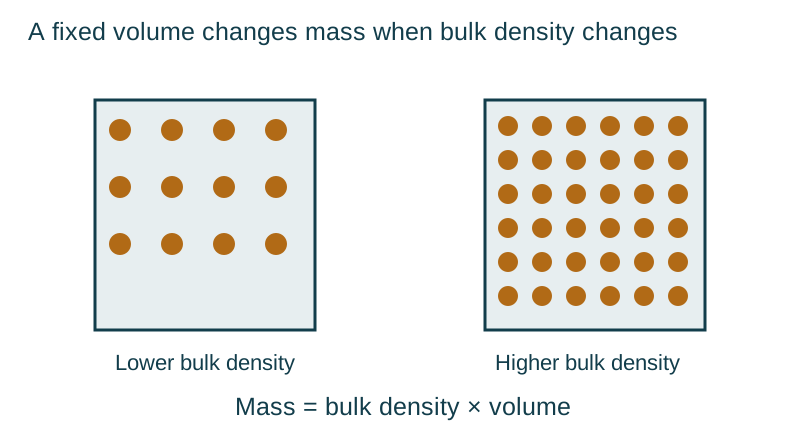
For volumetric delivery, mass = bulk density × delivered volume. If the occupied screw volume is repeatable but the bulk density changes, the delivered mass changes. Hopper level, aeration and consolidation can alter the relationship between screw turns and mass.
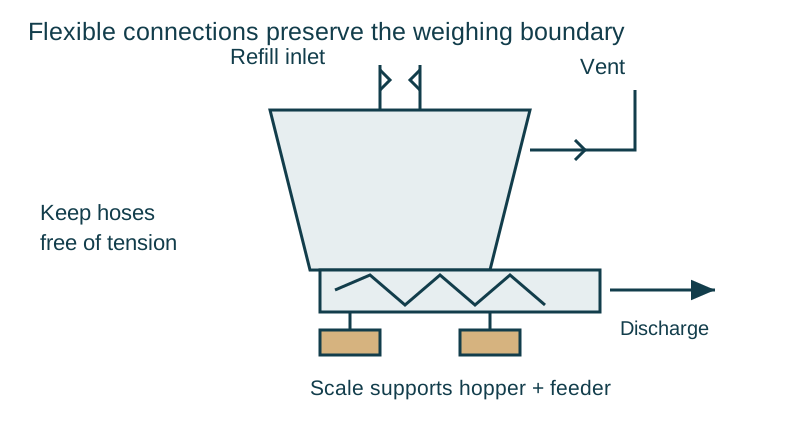
A gravimetric auger installation measures mass during or after delivery and uses that information to control or correct the fill. It still needs stable mechanical loading, suitable filtering and a repeatable cutoff. Check whether the advertised feedback operates on each fill, on a downstream sample or as a correction based on earlier packages.
Combination weighing also depends on product flow. Its measurements can identify the portions already in the hoppers, but the controller cannot select a useful combination if too few hoppers are ready or if portions remain stuck after opening.
Evaluate damage, dust and cleanability
For fragile particles, inspect damage after the complete transfer path and compare with the incoming product. A reduction in vibration may protect product while reducing replenishment; assess the combined outcome. For powder, inspect dust escape, contamination of seals and the effectiveness of the containment arrangement under the site’s safety controls.
Assess cleaning access and reassembly with the actual contact parts. A claim about stainless steel or a hygienic option does not establish the suitability of every configuration for your allergen, wet-cleaning or hazardous-area requirements. Request the relevant construction details and cleaning instructions.
Validate cutoff and package quality
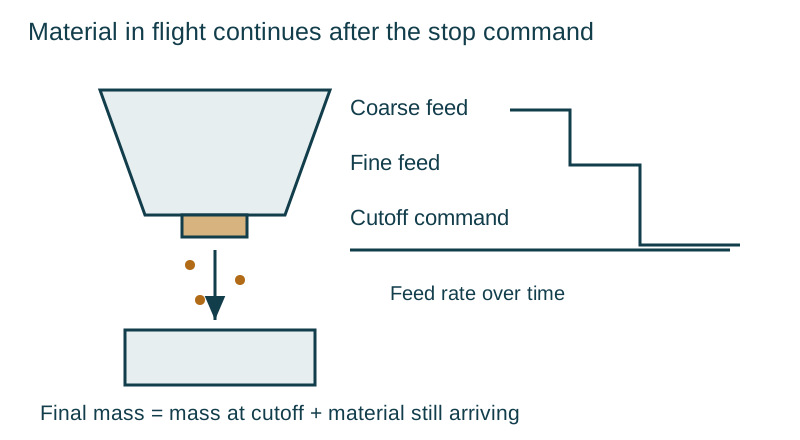
A scale-based fill often uses coarse feeding, fine feeding and an advance cutoff to accommodate material still moving toward the receiver. The final mass depends on both the measured mass at cutoff and that remaining material. Evaluate short and long runs, hopper refills and starts after downtime.
Measure package-weight distribution, product damage, dust, seal contamination, cleaning time and changeover effort at the same production conditions for both candidates. Keep supplier-specific settings with the trial record. A useful comparison is the complete accepted package at the required cadence, not an isolated feeder speed.
The volumetric and gravimetric control guide explains how to identify the feedback arrangement before comparing machine quotations.
Continue with the packaging weighing systems collection.