In this guide
Volumetric filling controls a volume-related quantity such as displacement, screw turns or a timed flow. Gravimetric filling uses measured mass as a control input. Select between them by identifying what the product specification requires and what changes during production, especially density, flow behaviour and the time available to make a decision.
Identify the measured quantity
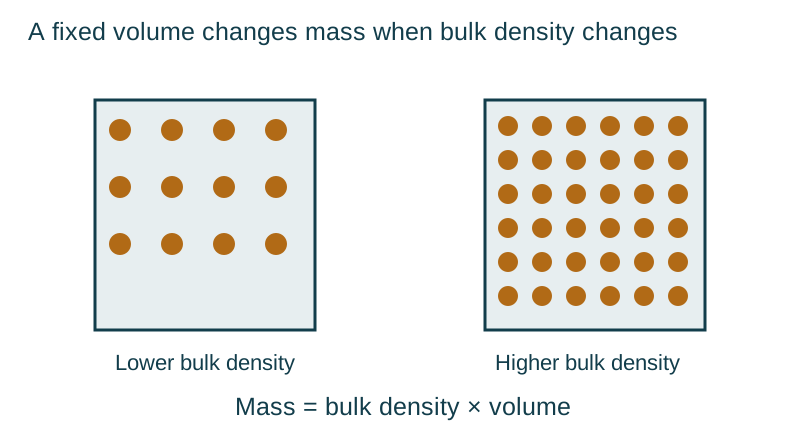
For a volumetric dose, mass = density × volume. A repeatable volume can therefore produce changing mass when density changes. This matters for aerated powders, products that settle in the hopper and liquids whose density changes with condition.
Mengibar describes volumetric liquid-filling systems, while Multi-Fill applies volumetric portioning to a different range of food products. These examples show why the phrase covers several mechanisms. Ask a supplier what is measured, which variable is controlled and how the controller reacts when the product changes.
Separate three gravimetric arrangements
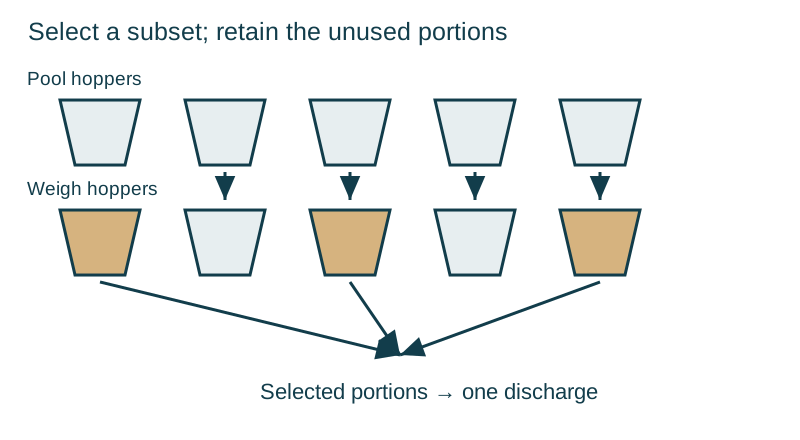
In gain-in-weight filling, the receiving vessel or package is weighed as material arrives. In a combination weigher, separately measured portions are selected and then discharged. In loss-in-weight feeding, the supply hopper and feeder are weighed and the controller calculates mass flow from the rate of weight decrease.
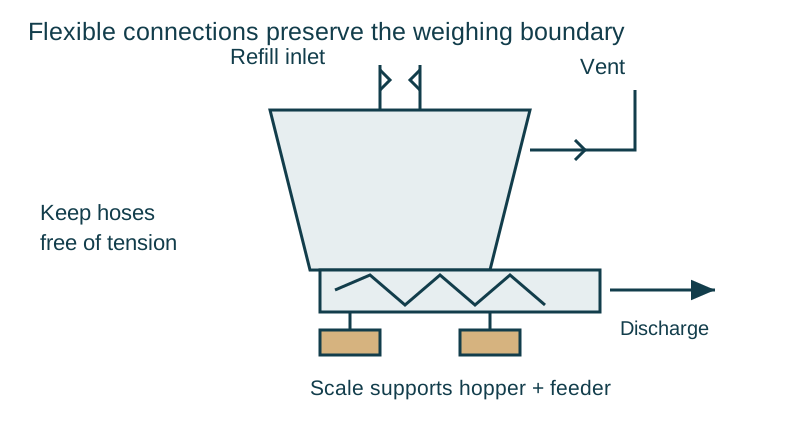
Those arrangements have different exposure to container tare, external connections and product travel. A downstream checkweigher can also provide feedback to a filler, but that feedback arrives after the affected package has been filled. Distinguish correction of future doses from direct control of the current dose.
| Control arrangement | Observed quantity | Main verification question |
|---|---|---|
| Volumetric displacement or turns | Delivered volume-related motion | Does product density or screw filling change? |
| Gain-in-weight | Increase in receiving mass | Does weighing remain stable during delivery? |
| Combination weighing | Mass in separate hoppers | Does the selected portion transfer completely? |
| Loss-in-weight | Decrease in supply mass over time | How are refill and external forces handled? |
| Downstream feedback | Completed-package mass | How quickly and safely are future fills corrected? |
Allow for the complete response time
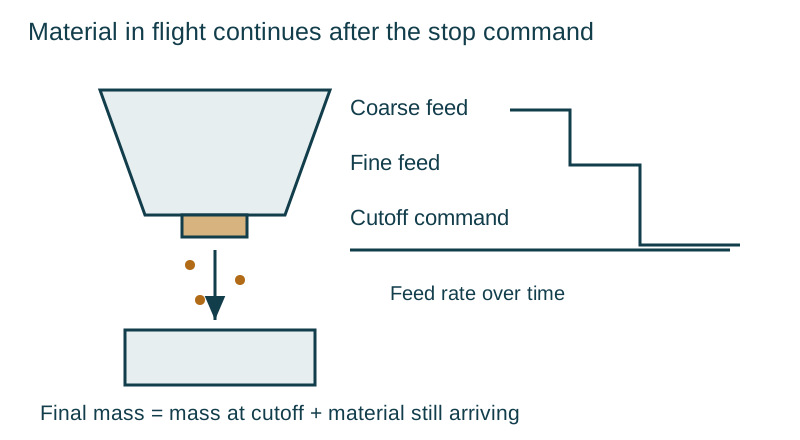
A scale does not stop product instantaneously. Measurement filtering, controller calculation, communication, actuator movement and product travel all contribute to delay. A coarse/fine filling sequence reduces delivery near the target, and an advance cutoff accommodates the material still arriving.
Spee-Dee lists net-weight auger filling alongside its other auger offerings. Thus “auger” and “gravimetric” can describe the same installation at different levels: one is the delivery mechanism, the other the feedback principle. Confirm the scope of the quoted configuration and how it determines the final cutoff.
Verify the unstable parts of the cycle
Test starts after idle time, changes in hopper level, refills and the upper and lower production rates. Evaluate individual dose mass and its distribution alongside throughput. A steady run at one density can conceal the reason a volumetric relationship changes later.
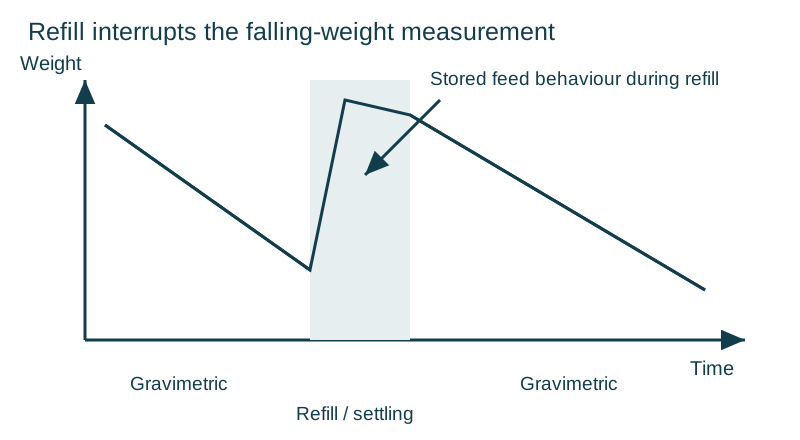
For loss-in-weight feeding, the scale gains mass during refill even though discharge may continue. The controller must treat that interval differently from normal falling-weight measurement. Thayer describes control routines for refill, density and environmental disturbances; the exact implementation is system-specific.
Build a selection record that survives changeover
Document product identity and condition, target quantity, packaging format, flow behaviour, permissible variation, required cadence and cleaning needs. Add the actual measurement boundary and the complete cutoff sequence. Record which conditions were tested and which require a further trial before production release.
A volumetric approach may be appropriate when volume is the required quantity or the mass-to-volume relationship remains controlled. Gravimetric feedback directly addresses mass variation, but still needs a mechanically sound measurement and predictable product transfer. The practical choice is the arrangement that produces accepted packages under the conditions the line will encounter.
Use the multihead versus auger comparison to connect these control principles to powder and particulate handling.
Continue with the packaging weighing systems collection.